| Workshop Results: Designing Desires
The Challenge
What new ideals could direct the way we cultivate desires with our product designs and guide us to more sustainable patterns of consumption?
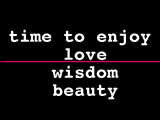
Love, Wisdom and Beauty
It is not difficult to distinguish hundreds of desires that are driving forces in our lives. When we try to determine which of these desires are the most important to us, we may realize that we have enormous lists of WANTS, but minimal actual NEEDS. In fact, we spend most of our lives trying to get or own a great range of wants which do not correspond at all to our real needs. Ultimately, life is not about needs, not even about desires, it is about meaning.
 The central principles from which all other desires and needs emanate are, according to the Designing Desires group, LOVE, WISDOM and BEAUTY. Of course love, wisdom and beauty are quite well-known to most people. Are these a cliché, a triviality? Not if you look at designers' attitudes. The Designing Desires group realized that in their present design work they do not deal with these issues at all. Instead, they are diverted by trivial appearance, function, perceived function and the mechanism of satisfying the client (and sometimes themselves). The central principles from which all other desires and needs emanate are, according to the Designing Desires group, LOVE, WISDOM and BEAUTY. Of course love, wisdom and beauty are quite well-known to most people. Are these a cliché, a triviality? Not if you look at designers' attitudes. The Designing Desires group realized that in their present design work they do not deal with these issues at all. Instead, they are diverted by trivial appearance, function, perceived function and the mechanism of satisfying the client (and sometimes themselves).
The central principles Love, Wisdom and Beauty have three levels of manifestation: in the CONCEPTUAL, because they exist primarily as values, concepts or ideas; in the SERVICES of life as actions and professions through which people express themselves and do their work; and in the most tangible form as PRODUCTS which embody the principles.
Love, wisdom and beauty manifest themselves in objects and services, but cannot be added onto them. As designers, we want meaningful designs which embody values like love, wisdom and beauty.
 The Designing Desires group, in conclusion, asks you to consider three of many possible questions: The Designing Desires group, in conclusion, asks you to consider three of many possible questions:
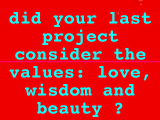
* Did your last project consider the values love, wisdom and beauty?
* If gifts are a substitute, why not give the real thing?
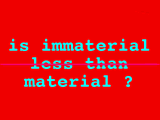
* Is immaterial less than material?
The Participants
- Tulga Beyerle, Teaching Assistant, Hochschule fur Angewandte Kunst, Vienna, Austria
- Niels Peter Flint, O2 International, Denmark
- Juoni Linkola, Student New Media Studies, University of Art and Design Helsinki, UIAH, Finland
- Sytze Kalisvaart, O2 Global Network, The Netherlands
- Bianca Maasdamme, Policy Official, Ministry of Housing, Spatial Planning and the Environment, Directorate-General for Environmental Management, The Netherlands
- Tad Mann, architect / astrologer, Denmark
- Tim Parsey, Design Manager, Industrial Design Group, Apple Computer Inc., USA
- Nancy Spanbrook, Lecturer, Curtin University, Australia
- Stefan Tax, Social Scientist Researcher, KPN Research, The Netherlands
- Agnes Willenborg, Interaction Designer, Lijn Vier Multimedia Design, The Netherlands
- Ronan Hallowel, Student of Philosophy and Religion and DJ, USA
- Fred Manskow Nymoen, Designer, Art Center College of Design, USA
- Jan -Christoph Zoels, Industrial Designer, Jan van Eyck Academy, The Netherlands

MAPPING GLOBAL PROCESSES
URBAN FOOTPRINTS
DESIGNING DESIRES
TRAVELS TO THE EDGE
BEYOND BEING THERE
ELECTRIC STORYLINES
ETERNALLY YOURS
INFO-ECO WORK
VIRTUAL VS REAL COMMUNITIES
INFO-ECO SOCIAL CARE
INFO-ECO EDUCATION
HEALTH AND INEFFICIENCY
|